Showing posts with label sculpture. Show all posts

a conversation with Catherine Willis

....
"Prenant appui plus sur le vide que sur le plein"
leaning more on emptiness than on fullness.

"Forms happen in an effortless, natural way."


Porte-Plume:
slate, copper, perfumed silk, feathers, 2005, J.S. (U.S.A)


It was a few years ago that I was introduced to Catherine Willis' works through Ivan Terestchenko. Immediately, I found myself connected to her forms, her connection to nature, and to her use of scents, or "offerings", as she might call them. She told me that "if you are really quiet, everything has a scent, even the pebbles, even the meteorites."

It is in this stillness, that we can see, I believe. It is through artisans such as Catherine Willis, that we are able to "see" and experience the world. Catherine's work has many layers, and it has been difficult to wrap my mind around it without spending an afternoon with her in her studio. Scent is important to her work, and the experience of being present. Perhaps, it will happen in the future that we shall meet. But in the meantime, here is the conversation between Catherine and I, some of it in French and English. Letters passed back and forth in an attempt to understand her forms through images and words.

It is late tonight, and I am quiet, off to look for meteorites.

Thank you Catherine, and to Ivan. Always. - David John


above photograph by Ivan Terestchenko


I wrote to Ivan about Catherine when I began working on this interview, asking where they met:

"I met Catherine for the first time is the most auspicious and hospitable garden at a common friend's party. She was wrapped in the one of these textiles from a far away exotic and unpronounceable somewhere. It was a good start. Catherine turns whatever she touches into art. She eats, breaths, sleeps in art steadily, persistently, relentlessly with a communicating enthusiasm. Catherine is the ultimate artist in every possible sense of the word and a wonderfully gifted one too."

- Ivan Terestchenko


top: "PERFUME RING" January the 17th meadowsweet dyed silk, figtree branch, tonka beans, black cotton ligatures, sprayed with cardamom and labdanum tinctures. 2012


bottom: "TOOL FROM MY SHAMANIC GARAGE" seeds, porcupine quills, figtree twig, shell from Capbreton, cinnamon colored cotton ligatures, black cotton, sprayed w/labdanum tincture 2012


The conversation :


Scent. Will you explain how the sense of smell comes into your work?

Catherine: I consider my work as an exploration and a celebration of nature. To pay attention to smell is my way to observe quietly what I encounter on my path, a form of meditation, "Caminando se hace el camino." (translated, "walking is the way"). My blog is called Chemin Faisant. If you are really quiet, everything has a scent, even the pebbles, even the meteorites.

It is my way to acknowledge the mystery of being alive on this planet.


the perfume rings: exhibition curated by Diana Esnault-Pelterie.


Where do the scents come from, plants or other material? Where do you find these materials?

Catherine: I like to experiment. So, often I will use the propolis from my beehive, or precious scented woods brought back from souqs, or given by friends. The Perfume Rings are half filled with scented fragments and the pomegranate-dyed silks are impregnated with perfume.


How do you arrive at the forms in your sculpture? Do the scents find themselves involved in your works on paper?


Catherine: Forms happen in an effortless, natural way. I like the concept, developed by Soetsu Yanagi in his book "The Unknown Crafstman," of objects born, not made. On paper (I am always looking for interesting papers) I often use essential oils as pigments. But, I can also use bought beeswax based pastels or watercolor


the beast, 2010


Home of Ellen de Generes &Portiade Rossi. Photo from Architectural Digest, by Roger Davies

Catherine Willis' work, "Perfume Captor/ Capteur De Parfum."


Tell me about the bronze works?


I am only beginning to translate my white plaster sculptures into white patina bronzes. So far there is a photo of Bronze Parfume, the piece that now belongs to Ellen de Generes and Portiade Rossi on my site. Also in my site a photo of La Foret, portrait en pied ( with green patina bronze feet ) a piece that belongs to an Italian collector of mine, in Paris.


How long have you considered yourself an artist?

About 30 Years, I suppose. I consider being an artist is a way of life. So it does not stop when I am outside my studio.

Does sound influence your work? I noticed your installations with others involve music.

Perfumes, colors, sounds are wave lengths. I recently have begun a performance-concert project with a Brazilian musician friend from Paris, Pedro de Alcantara. He sings in overtones and plays his cello while I burn perfumes.


I'm particularly interested in an older work of yours,
7 DOORS, 7 PLANETS, 7 PERFUMES, Paris from 1985
.

This was the first time, in front of Charles Sablon Gallery, it has now become Musée du Montparnasse, that I was doing an installation with this correspondence between heaven and earth, between the days of the week, planets, metals, colors, perfumes. Monday, the moon, silver, pale yellow, an oak moss perfume. The spectator would go through these seven light cotton doors and smell the perfume hidden in the hems. (the ancestors of my Perfume Rings)

Since I have done several installations on the same theme ( two in the baroque Paris chapel of the Salpetriere, one performance in Venice with a pianist friend J.P.Armengaud at Ca Rezzonico in the Pulcinella room. The last one on this correspondence team is a perfumed garden I designed in Goa (together with French garden architect Alain Richert and Indian architects Nita and Arvind de Souza) for an Indian friend.

Seven granite altars on which the perfume of the day would be burned at sunset, seven colors for the flowering plans of each section of this garden by the sea.


lustre blanc, led, white plaster chandelier.2009.Pièce unique.Collection Cl. de B. France.


LUSTRE BLANC LED, the white plaster chandelier. Have you made any more hanging lights?
Were you happy with this work?

Lustre Blanc is une commande (the english word is probably commission ) from a French collector & friend of mine for the dining room of her manor house near Paris. Yes, I was happy with this work!

I have another lustre in preparation, also white plaster but bigger and with all the wiring outside, apparent. At the moment I am also making white plaster candle holders, waiting for a collector to order 2 or 3 before having them cast in white patina bronze.


The direction of your new work?


It seems my work tends to be more and more like a celebration of Nature, shamanic offerings. From cosmic events to scented plants, I celebrate color and perfume of the origins, the tension & lines of evolution, the patterns that connect.

It seems it gets lighter too, "prenant appui plus sur le vide que sur le plein": leaning more on emptiness than on fullness, like for my sculptures to be hung from the ceiling.


Who or what influences you?


Brancusi, Noguchi, Tea bowls masters, Chinese, Koreans, and Japanese Rothko, Man Ray, Piero della Francesca, John Berger, Krishnamurti, Eckardt Tolle, Jean Giono, Nicolas Bouvier, Gary Zukav, and recently Michael Ondatjee As for music, Jean Sebastian Bach, John Cage,Iranian and Indian music. Oh, I have forgotten Rainer Maria Rilke, Federico Garcia Lorca, and Wolfgang Laib.


Catherine Willis' portfolio here

visit Chemin faisant here


Not all those who WANDER are LOST." J.R.R. Tolkien


...

You have read this article catherine willis / french artist / perfume rings / scents / sculpture / yhbhs interviews / you have been here sometime with the title sculpture. You can bookmark this page URL https://gigibytes.blogspot.com/2012/03/a-conversation-with-catherine-willis.html. Thanks!

Larry Bell

.
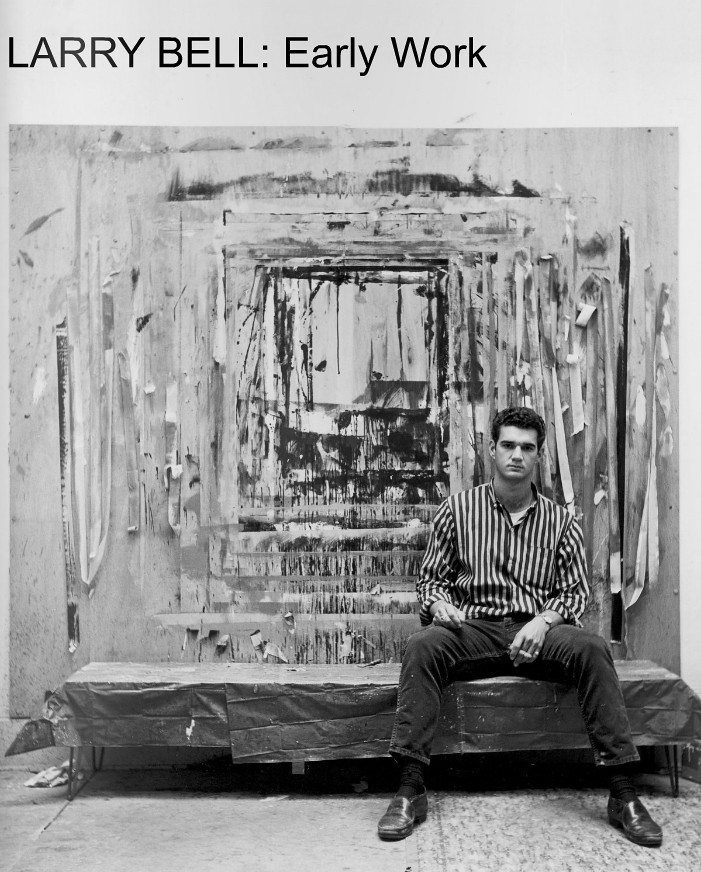
"Larry Bell expanded the two-dimensional illusion
of a geometric form into actual space..."


Larry Bell : Early Work: October 22-November 26, 2011
Frank Lloyd Gallery, Santa Monica


"Most of my associates thought I was crazy to go to such ends just to work, but I was on a path that I felt needed total control of the media of working with light and its interface with the surface of the glass. By this time, I was aware that my media had no more to do with the interface than it did with the glass material. Glass had three qualities that were interesting to me, it transmitted, reflected, and absorbed light at the same time.

- Larry Bell


"Larry Bell's innovative sculptural work is integral to the development of the clean, clear look of Los Angeles art. Significantly, several series of paintings preceded the artist's well-known cubes and environments of the later 1960s. These early works, from the years 1959 to 1963, show a progression from paintings influenced by Abstract Expressionism, to early shaped canvases, to Bell's incorporation of geometric form within paintings."


Larry Bell's inquiry was driven by his sense that the image should relate directly to the plane of the canvas.
In these early works, Bell focused on visual perception and his questions led him to eliminate distractions such as gesture and tactile layering of paint. That focus on planes and the reduction of gesture meant that the image could suggest volume. In a work from 1961, Untitled, Bell introduces the illusion of a sculptural volume as well as the use of mirrored glass. Other pieces included in the exhibit employ glass, wood and paint and demonstrate the artist's interest in the medium of reflected light.


As Michele De Angelus has summarized, "…Bell expanded the two-dimensional illusion of a geometric form into actual space: his canvases became thick panels with the addition of clear and opaque, black and white glass and mirrors."


(text taken from here)


Link


"Frank Lloyd Gallery, established in 1996, represents contemporary painting, sculpture and ceramics. Primarily emphasizing major West Coast artists that emerged since 1950, the gallery also presents ceramic sculpture in the context of the contemporary art world. The recently expanded exhibition program featured a show titled Sculpture from the Sixties, which included major works by Robert Irwin, Craig Kauffman, Larry Bell, as well as Ken Price, John Mason and Peter Voulkos."


-----------------------
You have read this article glass sculpture / larry bell / sculpture / west coast art / when canvas becomes art with the title sculpture. You can bookmark this page URL https://gigibytes.blogspot.com/2011/10/larry-bell.html. Thanks!

YHBHS interview with MARI ANDREWS

....
"I often make up words for titles, sometimes even in fake Latin. I love all those syllables and how they roll off the tongue. I like to misspell words so the title becomes understood phonetically. Other times I use verbs, or descriptive passages, or lines of poetry. Titles come about in many ways."

- Mari Andrews


the studio of Mari Andrews....


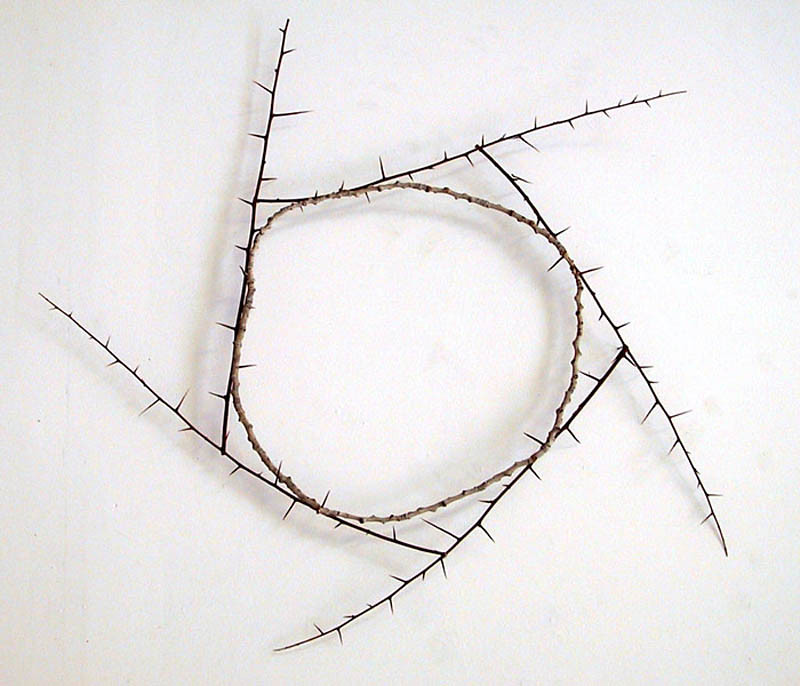
Mari Andrews has been working for over twenty years with materials that some might walk past, not even stopping to think twice about what they are actually seeing. The first time I discovered Mari's work, I connected to a sense of quiet purpose in her work, a sense of doodling with forms and abandoned materials, creating subtle arrangements in space. Her twisted thorns, lichens, and dangling rocks recall the art of ikebana, a quest for balance and beauty. But her formations of silicone coated wires make me think of mindless afternoons sketching, or the curves of the road that lead to Big Sur, also known as the Pacific Coast Highway. It's as if she has created maps with the objects she has discovered upon her own walks and trips, and drew them on the wall for us to use. If these works are maps to an unknown land, you'll see me on the other-side, looking for bubbling fountains and endless mountain views. Thank you Mari......

Mari Andrews' work is part of a summer group exhibition at JK Gallery in Los Angles.


2 untitled works from 2000


Can you talk about your choice of materials you work with for your sculptures? And how they came about?

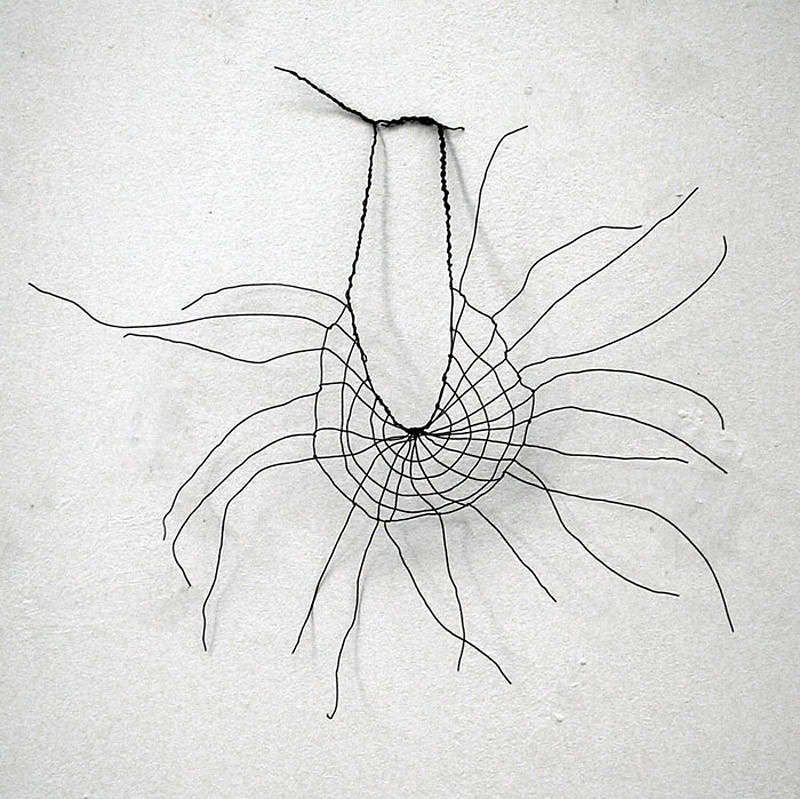
I work primarily with annealed steel wire which is black. It feels like a pencil line to me. (Almost everything I make I consider to be a continuation of my drawing practice.) Sometimes I add black silicone to the wire, and then it becomes a charcoal line. I combine various man-made and found materials with the wire, to make "hybrids". I have collected found objects for decades and it was very satisfying to bring these objects into the work - a synthesizing Eureka moment actually. Sometimes the collected material will spark an idea for a sculpture. Other times I have a fairly solid concept or drawn-up plans and look about my raw materials to select the right combination of things to carry out that idea. I have also sought out things to make or complete a piece. This is true of the lichen in "Lichen Square" in my upcoming JK Gallery show. I needed a batch of lichen and headed to the Northern California coastal range to collect it.


Where do you collect the materials for your works?

I collect all the time, although I have had to become more discerning for lack of space. I take walks in the city and pick up human detritus from the street. There is rusted metal wire and odd bits on construction and destruction sites, also along railroad tracks. I collect seeds, leaves, pods and branches while hiking, stones while walking river beds, other stuff washes up on coastal shores. I sometimes use kitchen compost like squash or melon seeds, and garden trimmings, too. Once in a great while people will bring me their findings. I take donations .


If you were not a sculptor, you might be.....? A biologist, botanist, geologist, and maybe a sociologist.


Accoil, 2009, wire and acorns


What does "Acocoil" mean? or "Alphanet"? How do your titles comes about, and what are they referencing?

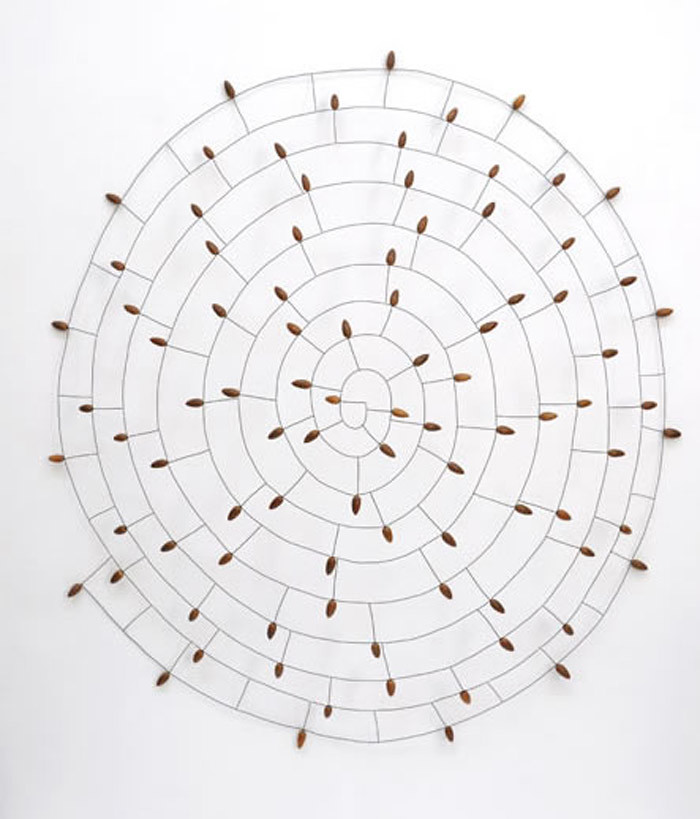
"Acocoil" is a hybrid of the words Acorn and Coil, I made it up. It is a very basic description of form and materials used in the sculpture. The sculpture "Alphanet" contains 26 manzanita leaves attached to the ends of a wire mesh. Each leaf has an alphabet pasta glued to the face of the leaf. Twenty-five different letters were used with one repeated, so not every letter of the alphabet is represented, one is missing. It couldn't be perfect in my mind, so I made a "purposeful error", like in a Navajo rug. So "Alphanet" is also, a hybrid of a couple of words. I often make up words for titles, sometimes even in fake Latin. I love all those syllables and how they roll off the tongue. I like to misspell words so the title becomes understood phonetically. Other times I use verbs, or descriptive passages, or lines of poetry. Titles come about in many ways.


"For the most part these three-dimensional drawings are presented on the wall. They are made as singular pieces and often come together in larger wall installations. The individual works relate to and play off of each other like words forming sentences or sentences telling a story. "
What are you communicating with your works, what is one of the many stories you are telling?


The quote about "telling a story" is a really a metaphor for the way the sculptures interact with one another. They are like family members, related but different. They can stand alone or be read as a group of "related" elements. When they are presented together I feel that there is a richer, more complete vocabulary of form. I'd like viewers to walk away from my work with a deeper curiosity/observation of one's surroundings. This includes our urban environments as well as the natural ones. Perhaps if we slow down and take in what is around us we will be more inclined to appreciate and protect what we have left of our natural environment. So there is an underlying environmental message.


You mentioned, the objects often times reflect our "human sensitivities and vulnerabilities." Will you talk about this?

I believe that the delicacy and tenderness of some of the materials I use have similar qualities to human emotion, human condition. The objects can be physically fragile; they age, crack, break, fade. Some are sturdy but flexible like the willow. Some are thorny and defensive like cactus spikes. Some look thorny but are soft and pliable - as in silicone. The combination of materials sometimes yield humorous effects - - another very important human quality, I believe. The hundreds of "paperless drawings" I have made are representative of the diversity found in our society; the multitude of people, cultural backgrounds, points of view.


Who or what captivates your attention?
Bees, human psychology, long vistas, my garden, the western state deserts, high altitude streams, liberal politics, petroglyphs, abandoned mines, sense memory, obsolete tools, the oldest living things, spiders, poetry....


Among artists?
Ann Hamilton, Anish Kapoor, Martin Puryear, Gego, Herman de Vries, Terry Winters, Eva Hesse, Kiki Smith.....


Does your work ever frustrate you?
Oh yeah! I'm not technically as proficient as I'd like to be to carry out some ideas. I also find that some ideas are difficult to translate into any materials.


circuit 2006, wire and silicone


please take a look at Mari Andrews' site.

Mari Andrews July 16, 2011 — August 20, 2011
JK Gallery, Los Angeles
2632 S. La Cienega Blvd. Los Angeles, CA 90034


----------------------
You have read this article art / art interview / becomes sculpture / mari andrews / paperless drawings / sculpture / YHBHS interview / yhbhs interview with mari andrews with the title sculpture. You can bookmark this page URL https://gigibytes.blogspot.com/2011/07/yhbhs-interview-with-mari-andrews.html. Thanks!
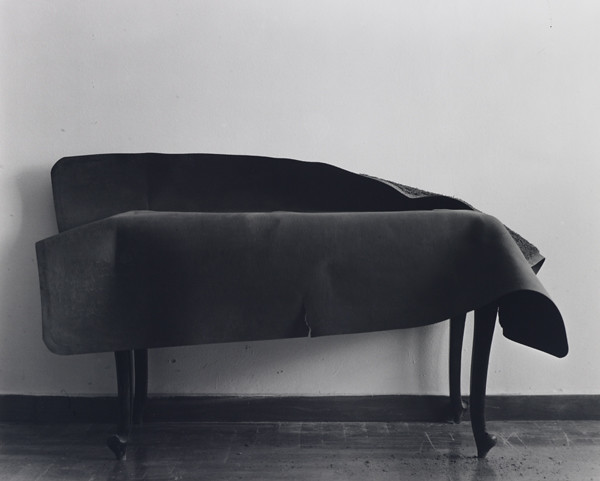
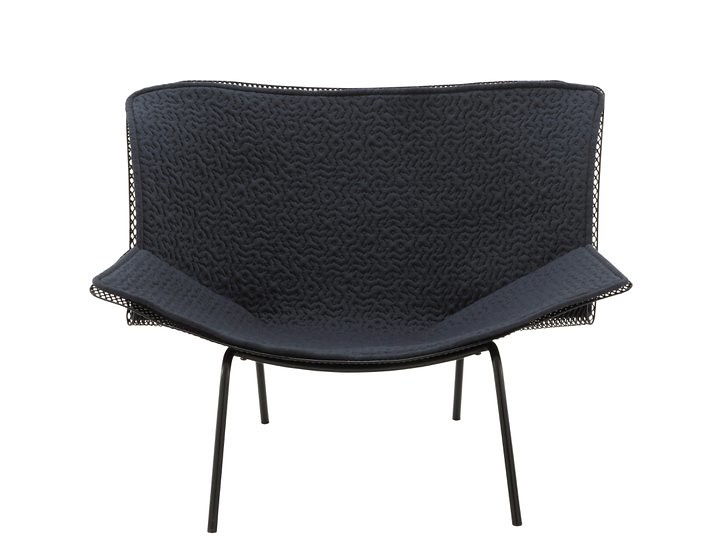
"I believe that meanings in sculpture emerge more powerfully
when they are carried through sculpture's own silent language"


Becky Beasely

vs
Francosi Azambourg

"for tonight, we will hold each other until dawn"


grillage:

1. A framework of heavy timbers, steel, or reinforced concrete beams laid longitudinally and crossed by similar members laid upon them to spread a heavy load over a larger area, esp. for use where the ground is not firm.

2. A series of steel beams, bolted together and placed over a footing; used to distribute a concentrated column load over the top of the footing.


--------------


"If human beings respond so decisively to mood and environment, and also to space and proportion in architecture, then it is possible to, and imperative that we should, rediscover those perceptions in ourselves, so that architecture and sculpture can in the future evoke those definite responses in human beings which grew with Venice and still live to-day. Sculpture should act not only as a foil to architectural properties but the sculpture itself should provide a link between human scale and sensibility and the greater volumes of space and mass in architecture."

"In opposition to 'social realism' I believe that meanings in sculpture emerge more powerfully when they are carried through sculpture's own silent language; and that if the sculptor himself can find personal integration with his surroundings and his community his work will stand a greater chance of developing the poetry which is his free and affirmative contribution to society."

"So many ideas spring from an inside response to form: for example, if I see a woman carrying a child in her arms it is not so much what I see that affects me, but what I feel within my own body. There is an immediate transference of sensation, a response within to the rhythm of weight, balance and tension of the large and small form making an interior organic whole. The transmutation of experience is, therefore, organically controlled and contains new emphasis of forms. It may be that the sensation of being a woman presents yet another facet of the sculptural idea."

-Barbara Hepworth


-------------------

You have read this article art / becky beasely / sculpture / when furniture becomes sculpture with the title sculpture. You can bookmark this page URL https://gigibytes.blogspot.com/2011/06/i-believe-that-meanings-in-sculpture.html. Thanks!

T R E E S

the stone tree of Los Angeles
the steel tree in Central Park.

"I've processed the idea of a tree and created a system for its form. I take this organic majestic being and break it down into components and rules."
-Roxy Paine


the trees are made of stone.
the trees are made of steel.


1. Jud Fine, Los Angeles
2. Roxy Paine, Bluff 2002, Central Park


Jud Fine took his cue for the station artwork from the Greene & Greene-designed Oaklawn Waiting Station, built in 1906 on Fair Oaks Avenue. For the station project, Fine created an 18-foot tall copper-bound “Stone Tree” with bluntly cut limbs that rise staunchly amidst a backdrop of heavy wood beams and arroyo stones. Referencing the mythical tree of life, it stands as a formidable icon to the Craftsman Style of architecture known throughout the area, and represents the movement’s joining together of natural elements and human design. text taken from here....


Roxy Paine uses both mechanical means and the innate logic of natural forms to create his "Dendroid" tree-like sculptures. Paine's meticulous research and observation of a variety of tree species help him to understand the "language" of how a tree grows, and from there he creates fictional tree species that grow to a logic of their own.


-----------------------------
You have read this article artist / central park dendroid / dendroids / jud fine / roxy paine / roxy paine dendroid / sculpture / trees with the title sculpture. You can bookmark this page URL https://gigibytes.blogspot.com/2011/03/t-r-e-e-s.html. Thanks!
I'll only know
(what i know)
until the dawn comes.

the life of a lonely retail merchant.


I'll only know
(what i know)
until the dawn comes.


images:
1. Gabriella Crespi
2. Marco Brunari (?)


Gabrielle Crespi:

Her guru, a disciple of Babaji, himself said to be an incarnation of Krishna, is the ''Yogi-Christ of Modern India.'' And, in a sense, Crespi is experiencing a kind of rebirth, too. There is a renewed interest in her furniture and accessory designs — about 1,500 all told, including lamps, silverware and jewelry, in a huge range of materials, from metal, wood, marble and bamboo to seeds, shells and gemstones. Produced mainly in the 1960's and 70's, her creations graced some of the most elegant homes in the world. Elizabeth Arden ''fell in love with my designs, and wanted everything in the collection,'' Crespi said recently. Thomas Hoving, Princess Grace, Gunther Sachs and the Shah of Iran were other aficionados.


from here...


You have read this article furniture as art / gabriella crespi / mirrors / sculpture with the title sculpture. You can bookmark this page URL https://gigibytes.blogspot.com/2010/11/ill-only-know-what-i-know-until-dawn.html. Thanks!
Portrait of a Man pt 27

"to be a man, is to be torn inside"
aka
"man's ulterior motives"

(see all portraits of men here.)


-------------


u l t e r i o r
1. adj. being beyond what is seen or avowed; intentionally kept concealed: ulterior motives.


Synonyms 1. hidden, covert, undisclosed, undivulged.


----------------


Portrait of a Man pt 27

"to be a man, is to be torn inside"
aka
"man's ulterior motives"


1. unknown image
2. Gavin Turk, new work, via Almine Rech gallery, here..
3. Francesco Barocco, here, via Norma Mangione Gallery


(see all portraits of men here.)


----------------------------


You have read this article bronze / gavin turk / men / portrait of a man / sculpture / ulterior motives / when sculpture becomes emotion with the title sculpture. You can bookmark this page URL https://gigibytes.blogspot.com/2010/11/portrait-of-man-pt-27-to-be-man-is-to.html. Thanks!
Matthew Monahan
new work,
Anton Kern Gallery. Nov 5 - Dec 23


Maurizio :You mentioned you have rules in the studio.

Matthew: No use of photography, no projections, no mannequins, no live models, no body casts, no ready-mades, no fabricators and no source material.

I am pretty dogmatic about this. When I stared with figurative work in 1995 it was so hard to concentrate I had to make sure I had no short cuts out of it.
It seemed like an ‘anything goes’ time in art and I felt that I had effectively dropped out. Charcoal drawing? How uncool is that? I just wanted see something that only I could make, and I thought I could find it somewhere in the face and in the body. If you fix the rules and the subject matter, you can really concentrate on the development of style, and by style I don’t mean fashion, I mean it like Barthes when he called style that “lonely and vertical dimension of thought, the product of a thrust and not an intention.” The loneliness could have been too much but I was in a kind of gang with two other artists, Tom Houseago and Micheal Kirkham.

We called ourselves “the crows,” and we really stuck to this dogma and supported each other in our new figurative adventure. Otherwise I think it would have been impossible.


(pulled from an interview with Matthew Monahan and Maurizio Cattelan..)
1972 Born in Eureka Lives and works in Los Angeles


Matthew Monahan’s work presents a futuristic archaeology. Drawing from a wide range of influences, from Modernist art to ancient totems, Monahan’s ‘artefacts’ are both familiar and strange.

Filtering historical mythologies through his own personal system of reference, altered further through the experience of making, Monahan’s work alludes to a contemporary spirituality, where beauty and brutality coalesce as virtual monuments.


(text taken from here.)


Matthew Monahan
new work,
Anton Kern Gallery. Nov 5 - Dec 23


---------------------
You have read this article anton kern / los angeles artist / matthew monahan / maurizio cattelan / portraits / sculpture / totems with the title sculpture. You can bookmark this page URL https://gigibytes.blogspot.com/2010/11/matthew-monahan-new-work-anton-kern.html. Thanks!
Related Posts Plugin for WordPress, Blogger...